
The Guardian Allotment Blog - January 4, 2008
Every Garden A School Garden
By
Kristin Collier and Nick Routledge
NICK: Once, I thought of gardening with children as incidental to the serious, adult work that occupies so many of us who are given over to exploring a regenerative ethic. I approached ‘gardening with the guileless’ in largely one-way terms - sharing what I ‘knew’ with innocents who, it appeared, clearly understood less than I about the principles and practice of sustainability. A decade later, I am aware that my perception has fundamentally shifted. Now, a pragmatic communion of the deepest needs of children and landscape informs the heart of my efforts to explore a coherent life. Gardening with children is not a sideshow; it is a dialog shining the brightest of lights upon what is most unsustainable in our world.
 KRISTIN:
I quite agree with you that children shine “the brightest of lights
upon what is most unsustainable.” They are, in many senses, the
closest connection that our culture has to the natural world. The shifts
we have made away from community, away from the earth, away from the instinctive
understanding of how to support children, the land, each other -- these
shifts are not contained in the tiny lifeforms that emerge from us. Our
infants still hold with clarity the patterned responses of countless generations
whose lives on this planet were sustainable. But they cannot speak them.
The wisdom they hold is not organized within the context of this culture,
and, given our current parenting paradigm, it is lost all too soon as
the grasp of a consumer society pulls them from coherence.
KRISTIN:
I quite agree with you that children shine “the brightest of lights
upon what is most unsustainable.” They are, in many senses, the
closest connection that our culture has to the natural world. The shifts
we have made away from community, away from the earth, away from the instinctive
understanding of how to support children, the land, each other -- these
shifts are not contained in the tiny lifeforms that emerge from us. Our
infants still hold with clarity the patterned responses of countless generations
whose lives on this planet were sustainable. But they cannot speak them.
The wisdom they hold is not organized within the context of this culture,
and, given our current parenting paradigm, it is lost all too soon as
the grasp of a consumer society pulls them from coherence.
The lessons we may learn from children, accordingly, are indirect. The
light is shone on the very way we respond to them, particularly clear
in the context of the garden, as we struggle to meld our desire for sustainability
with the instinct that is already apparent in these young humans.
First, we might ask ourselves: what brings us into the garden with our children? What needs do we, as adults, seek to meet there? Typically, we tell ourselves we are there to meet the children’s needs, but can we be more specific? Therein lies a glimpse of the complicated web we weave.
The needs of the children we most want to meet are not short term needs, I think, but rather the long-term needs for our sustainability. With an eye for the future that children rarely possess, adults predict that cultivating our food locally will support the survival of our species and the environment hospitable to it. With this in mind, we are motivated to turn to the garden, taking the hand of a child. We seek to share skills, understanding. We have a need to contribute and we seek to meet a need for meaning in sharing this purposeful work with children who might continue it.
Are we giving a gift our children are willing
to receive? This is a question that it takes great courage to face. It
is easier, instead, to step forward into the garden with their tiny hands
in our great ones, teaching the way to grow food as we have learned to
do it ourselves. Our expression of good will is unconscious of the children’s
present needs, and this is apparent to them. Their work, like ours, is
to meet their own needs. Only in a place of mutual understanding of all
needs will we discover a partnership that will truly serve children, adults,
and the earth.
What are the needs of children in the garden? The paths that children
create in a landscape emerge from their hearts. The places in the garden
to which they are drawn reflect their needs in the deepest sense. As adults,
we "head" to the garden with a desire to create, to accomplish,
to change the landscape so it reflects our understanding of what would
serve. We speak to the garden this way. My perception of the dynamic around
children in the garden is that they come into a landscape (as they enter
all circumstances) fully open to what it has to offer. They do not explore
with intention. Instead, they explore because the earth calls them to
it, and the way they take the earth in, if not misguided by our many "helpful
interventions" is closer to the model nature designed than any attempt
we make to comprehend our natural world after seeking to understand ecosystems
and molecular structure.
Children explore nature in a manner deeply simple, holistic, and attuned
to natural patterns and rhythms. It is not in our current paradigm to
respect this and learn from it. Observing with children and reaching for
our own curiosity is some great stride toward sustainability.
NICK: Our current paradigm holds useful insights, however. Thomas Hardy’s assertion that: "If a way to the Better there be, It exacts a full look at the Worst," describes my own experience in attempting to transcend a cultural paradigm fundamentally at odds with supporting the communion of children and landscapes. A full consideration of the unmet needs of children, adults, and the garden is teaching me about where a coherent path toward sustainability may lie.
I manage the greenhouse for the School Garden Project (SGP) of Lane County, Oregon. We support teaching gardens in sixteen Head Start pre-schools, the K-12 public school system, our local community college, and others. As such, there is a key focus on juggling the schedules of plants and schools. I am told that the school schedule was originally designed when we were a largely agricultural society, to allow children to return home to help with the summer harvest. The legacy is that no matter how soon in the spring we get plants into the ground, children return home for the summer break in the week or two that the very earliest crops begin to mature. As the adult stewards of these endeavors know only too well, garden educators are then left alone with the challenge of caring for a garden during the peak growing and harvest months of the year.
 The
SGP has cultivated many strategies to cope with this challenge. In the
greenhouse itself, we begin seeding before some of the most competitive
local market farmers break open their seed packets, so that we can get
these crops into the ground weeks before transplants have traditionally
come available to school gardeners. We also emphasize particularly quick-growing
crops and varieties, which affords us an additional two-to-three week
advantage in the earliest harvest window, and we focus on long-season
crops and varieties which will mature once the children return to school
in the fall. In addition, we are attempting to nurture the uptake of winter
cropping – the longest harvest season of the Pacific Northwestern
year - in local schools. This holds the potential of extending the school-year
harvest-window from a handful of weeks either side of the summer vacation
to 8-9 months, but here again, we consistently fall afoul of the fact
that children and teachers are simply not around to transplant and water
winter crops in the critical August timeframe.
The
SGP has cultivated many strategies to cope with this challenge. In the
greenhouse itself, we begin seeding before some of the most competitive
local market farmers break open their seed packets, so that we can get
these crops into the ground weeks before transplants have traditionally
come available to school gardeners. We also emphasize particularly quick-growing
crops and varieties, which affords us an additional two-to-three week
advantage in the earliest harvest window, and we focus on long-season
crops and varieties which will mature once the children return to school
in the fall. In addition, we are attempting to nurture the uptake of winter
cropping – the longest harvest season of the Pacific Northwestern
year - in local schools. This holds the potential of extending the school-year
harvest-window from a handful of weeks either side of the summer vacation
to 8-9 months, but here again, we consistently fall afoul of the fact
that children and teachers are simply not around to transplant and water
winter crops in the critical August timeframe.
The realpolitik is that many if not most school gardens crash in untended tatters over the summer vacation. Even so, our modest efforts have propelled us to the forefront of bioregional efforts to investigate what makes winter cropping work (we placed over 20 varieties of kale in local school gardens this winter season, for example, most of which have never seen American soil before). The SGP is emerging as a bioregional clearinghouse for winter cropping know-how and seed.
Fully committed to supporting the open-pollinated archetype, we have established relationships with some of the foremost independent plant breeders and stewards, both in the U.S. and Europe who support our efforts. Around our access to and choice of seed, in particular, we are able to explore a bio-cultural territory which exists, literally, beyond the ecological reach of the for-profit community – the territory currently occupied by organic agriculture, for example. Completely unnoticed, the most ecologically-resilient food crops in our bioregion are being planted by five-year-olds.
Then again, no matter how adept and fleet-of-foot our efforts, a fundamental incompatibility remains: the legacy of the harvest-at-home tradition as it relates to the school year is an intractable structural challenge to the school gardening system. The school schedule is at war with the gardener’s season.
Some souls, not unwise, suggest that if our culture has a future, then we will have to repattern our lives and understandings in accord with the cycles of nature. If so, then it is clear that the gardener's brand of Paradise involves knuckling down to some strict natural rules. The seasons cannot be moved. One major structural alternative to the current rut comes immediately to mind: we could bring the school year into line with the gardening season. Miracles do indeed happen but, for the time being, an ‘ecological conscience’, as Aldo Leopold put it, holds little currency. Besides, years spent relating with children in the realtime of the garden suggests to me that while the radical step of shifting the school schedule may well bring educational institutions back into lockstep with the major gardening season, such a move would do nothing to address the dissonance of a dominant child-and-landscape stewardship paradigm fundamentally at odds with the way children and Nature honestly function. You can change the set all you care to, but the stage remains the same. While putting kids in gardens at the time of year best supporting such activities is surely a move in the right direction, it is categorically not the same thing as honoring the natural patterns and rhythms of children and place once they are there.
 KRISTIN:
I appreciate the effort in Waldorf schools to tap into many of these natural
rhythms of children and earth. At the same time, the ultimate problem
as I, too, see it is the top-down way that we attempt to steward both
our children and the land. We can "hand-hold" the plants towards
a school schedule and take the children to the plants, but our hand-holding
tightens to a death grip as we make demands on the living systems of earth
and people which are outside of their natural coherence. All of our best
attempts are band-aids on the much greater need for a paradigm shift in
our approach to stewarding plants and children which takes into account
the natural growth habits and development of both.
KRISTIN:
I appreciate the effort in Waldorf schools to tap into many of these natural
rhythms of children and earth. At the same time, the ultimate problem
as I, too, see it is the top-down way that we attempt to steward both
our children and the land. We can "hand-hold" the plants towards
a school schedule and take the children to the plants, but our hand-holding
tightens to a death grip as we make demands on the living systems of earth
and people which are outside of their natural coherence. All of our best
attempts are band-aids on the much greater need for a paradigm shift in
our approach to stewarding plants and children which takes into account
the natural growth habits and development of both.
I homeschool my two children, ages five and seven. I have the opportunity
to observe them in their garden, and I am fascinated by what I am learning
there. First, their garden has grounded them in such a sense of place
that they rarely want to leave to go to the park or the houses and gardens
of friends. Secondly, the other children in our neighborhoods gravitate
toward our yard as both a playground and a sanctuary. The neighborhood
children are gone all day in public schools, and I wonder whether the
very groundedness of my children draws their friends to our garden magnetically
in ways that other settings do not. The children spend time in isolation
and in packs climbing the willow tree, weaving twigs, creating stick gardens
or just sitting under the sweeping cathedral of a red dog wood -- hiding
out in silence.
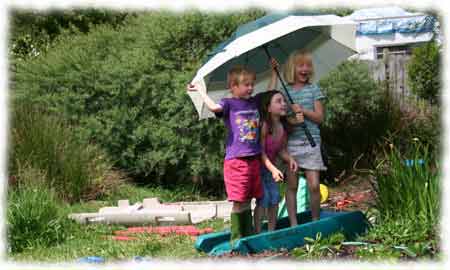
I watch these children interact with our quarter-acre yard in all weather,
all seasons, and all times of day and night. Last week, a group of four
children (ages 4 to 11) led me on a nighttime "haunted walk."
They had spent a couple of hours organically hatching a plan to terrify
me. In the dark, a string snare hung between towering sunflowers and hand-dug
"traps" in the ground caught at my toes. Working as a team,
they communicated with each other in secretive chirps and codes to signal
timing as each played their agreed parts, and the whole production unfolded
very theatrically. They jumped and giggled at my shrieks as they scurried
to their next posts to scare me again and again.
This example illustrates to me some key points
in consideration of the needs of earth and children. The garden created
a supportive structure for meeting so many of the childrens’ needs
as they entered it very naturally in a mixed age pack. The dark offered
a perspective of our yard that the kids were eager to explore. The very
nature of terror, largely banished in its most natural forms (how many
times have I been told in school playgrounds that the trees are not for
climbing?), came alive in a palpable way that the kids could harvest as
they were willing and able. Imitating the sound of a rattlesnake, one
girl stood in the shadows rubbing two jar lids together. Needs for power
met on her end; she could replicate the sounds of nature to frighten me.
The earthen traps demonstrated another gentle manipulation of the earth
to meet needs for power, fun, play. Clearly the entire experience supported
autonomy for children and adults (who were able to finish cooking dinner
in peace as the plot hatched), teamwork, exploration, and, perhaps most
importantly, connection.
How did the garden benefit? Connection, a beautiful and dynamic impulse
between people, is also clearly nurturing for the earth. The more time
these children spend on our little urban farm, the more fluent they become
around the needs of living things that inhabit it. They have learned some
by trial and error, but more by observation and the support that they
willingly give each other about how to nurture life in our garden.
 I
have turned 3-4 children at a time loose with pruning shears to take back
the ever-encroaching willow bush. The kids coach each other (particularly
the youngest among them) about the quantities that can be safely cut,
which plants should and should not be pruned, and where the sticks might
be taken to build brush-pile habitats for other urban fauna. They rarely
(if ever) make cuts that are painful to themselves or the developing plants
they tend. Other parents that visit are in awe at the awareness the children
demonstrate. The kids are quite content to sink into such workplay, using
tools that put them on par with adults in our culture's adult sense of
purpose. Of course, they are supervised. But I make an effort to give
only as much support and intervention as necessary to keep them safe while
celebrating their autonomy.
I
have turned 3-4 children at a time loose with pruning shears to take back
the ever-encroaching willow bush. The kids coach each other (particularly
the youngest among them) about the quantities that can be safely cut,
which plants should and should not be pruned, and where the sticks might
be taken to build brush-pile habitats for other urban fauna. They rarely
(if ever) make cuts that are painful to themselves or the developing plants
they tend. Other parents that visit are in awe at the awareness the children
demonstrate. The kids are quite content to sink into such workplay, using
tools that put them on par with adults in our culture's adult sense of
purpose. Of course, they are supervised. But I make an effort to give
only as much support and intervention as necessary to keep them safe while
celebrating their autonomy.
As the children come to know the earth and its rhythms, they become innocent
pawns in the rapture unfolding there. What child does not love to blow
dandelion seed or spin maple "helicopters?" Like squirrels,
they bury acorns and unearth them later to study and make "soup"
of the root structure. In these and countless other ways, children are
seeding, harvesting, pruning, mulching and making paths in their natural
world. If we learn by doing, the earth is heartily supporting a teaching
for these young people that will serve the planet. The connection cultivated
between the children and the earth as they support each other invites
a quality of care for our living world that is fast being discarded in
our concrete culture.
NICK: Yes, and this quality of care can manifest itself in unexpected ways. One major shift for me in my work with children has been an increasing willingness to let myself be steered. Frankly, it’s a direct outgrowth of a workable horticultural strategy: I have a need for ease. Cajoling children toward tasks that I find purposeful, but which they do not, never felt right, even as my head suggested my discomfort derived from a shortfall in my ‘persuasive abilities.’ As I now comprehend it, my unwillingness to make demands of children in the garden stems from an innate desire to meet children in a place of mutual regard for one another’s needs.
Five-to-eight year olds, for example, put high value on play, and these days, it is their playfulness in the Elementary School garden that I try to support, even as this may not tend to a specific garden priority I have in my mind. To this end, I make more of an effort to get to the tasks children are less inclined to, before or after the children visit the garden. This strategy meets my needs for focus and accomplishment while freeing the kids’ time up for activities more likely to engage them – planting seeds, transplanting starts, harvesting, pushing wheelbarrows, working with leaf piles, identifying insects, making flower bouquets. Such an approach also affords more room for what I consistently find is deeply meaningful to the children I work with - the opportunity to break out of a group of other children and to engage one-on-one, in shared playwork and meaningful conversation, with an adult who cares for them. For me, this is often a profoundly transformative experience where the stewardship of my own soul and that of the children and landscape fall into a trinity of seamless engagement and teaching/learning.
The shift into partnership with children, in consideration
of all needs, is clearly mirrored in my understanding of what our school
garden, and indeed every garden, now means to me. For a long time, I looked
at our garden in its mid-season ‘disarray’ and my heart sank.
Now, I treasure our garden’s flawed glory because although its jumble
comes nowhere near meeting rationalist standards of productivity and beauty,
the picture I see is a garden whose collective interiority is deeply peaceable.
Its wholeness is found in its balanced integrity. Its beauty rests in
a forgiving at-easeness with the immense constraints we labor under: an
ailing cultural context to which our efforts are inextricably bound, a
social stewardship paradigm fundamentally at odds with nature’s
rhythms, a great poverty of material resources, the low esteem with which
gardening with children is commonly held, our own brokenness as individuals,
and the willingness, above all, to meet children on their own joyful,
heartfelt terms in a landscape we are struggling mightily to learn how
to love. Its failings and ours, in other words, are a measure of our very
authenticity in holding to a course that is centered on the heart.
KRISTIN: Nick, I am so enjoying this image of the garden you put
forth: a paradise of acceptance rather than perfection. In acceptance,
I do not suggest that we stop mourning the painful aspects within the
structures (e.g. school schedules) that we see are not serving life, but
rather that we hold dear the needs that lie beneath them and honor this
care for the needs of all as it manifests in our garden landscape.
The way we view our garden again emphasizes the difference in perspective
embraced by children and adults. While children come into a living space
with an eye for what to hide behind, pluck, or climb, adults see what
they need to move in order to create food, sustainability in the garden.
Are these needs at odds with one another?
Fundamentally, I think not. In many cultures, as Jean Liedloff writes
in The Continuum Concept, “they [do] not distinguish work from other
ways of spending time." What are the needs we try to meet as we set
out to "work" in the garden? Accomplishment, engagement, sustainability
-- ultimately, these and many others can be rolled into "meaning."
This deeply felt need sits at the core of our connection with the earth
and our food. Now, imagining from a child's perspective, what are the
needs behind play? Engagement, exploration, accomplishment (these needs
could be on the adult list as well) -- again, I think these needs are
rooted in "meaning." Play and work are both purposeful, and
I believe that our efforts to distinguish them from one another does more
to raise conflict than cooperation.
When adults head to the garden and ask children to leave their play in
order to join the adult activities of organized garden maintenance, they
are asking the children to give up on their needs. As adults, we are telling
them that their needs are less important than ours, and usually we are
seeking to educate before connecting. Does this approach model the compassion
for earth and peoples that we most want to foster?
 NICK:
It clearly doesn’t. So many of the dichotomies which inform our
root approach to children and landscape don’t. The distinction between
work and play, home and garden, foodsheds and ecosystems, efficacy and
beauty are largely illusory. These dualisms are the product of a very
recent way of thinking about ourselves and the world, and one without
any fundamental evolutionary integrity. The notion, for example, that
we can nurture an authentic ecological sensibility in our children by
divorcing them from where they live and “educating” them in
school gardens, is patently absurd.
NICK:
It clearly doesn’t. So many of the dichotomies which inform our
root approach to children and landscape don’t. The distinction between
work and play, home and garden, foodsheds and ecosystems, efficacy and
beauty are largely illusory. These dualisms are the product of a very
recent way of thinking about ourselves and the world, and one without
any fundamental evolutionary integrity. The notion, for example, that
we can nurture an authentic ecological sensibility in our children by
divorcing them from where they live and “educating” them in
school gardens, is patently absurd.
Home is where this pilgrimage of the mind, body and soul needs to happen, where a sense of place is rooted, where the bonding of authentic human and non-human community can occur, where the simultaneity of restoring and re-storying landscape finds its communion. That is simply because home is where we live. I’ve made repeated efforts through the years to use schools as a platform for supporting gardening at home, sending children home with plants, offering husbandry training, and supporting these efforts with literature for parents. As a rule, parents are not yet ready to meet this challenge.
I have a sense that schools may yet serve as clearing houses for distributing the finest plant germplasm in our midst (nurseries as nurseries!), but the dictum “Every Garden, a School Garden” is categorically an idea before its time. Nine-to-five jobs, never mind the infrastructure that dictates much of modern living, make this notion seem impossibly quaint. But as I see it, ‘childrens’ gardening’ is fundamentally an oxymoron. ‘Family gardening’ is where we are headed -- by evolutionary necessity. It is painfully clear that we are a very long way from a cultural ethos which makes sense of adults and children alike simply staying home and settling in, together.
KRISTIN:
As conscious stewards of gardens and children, we sit at the cutting edge,
quite literally, of our culture's pain. We are at the place where the
fabric woven by the worship of material goods and strategy (rather than
need) is torn in two. We can see into the warp of that fabric from its
edge, and we yearn to weave a new tapestry from conscious compassion by
which to support life. From this edge, our view into the material chaos
that does not serve us is far superior than if we found ourselves seamlessly
woven into that fabric as so many people in our culture do. There is exquisite
pain in witnessing our world in this construct. It is somehow necessary
for us to see and hold this suffering in order to take up our work in
weaving a new pattern. The pain drives us with a sense of urgency and
we look to it to find clarity about what we do not wish to emulate.
This is the dynamic edge where I would like to call for a shift in the
way that we lead our children into the garden. As we reach out to reconnect
earth with its peoples, our youngest generation offers the most fertile
ground for change. Our children are truly the most grounded among us,
their instincts the clearest, their needs not yet fully masked by our
culture's dark veil. We may learn from them by watching their natural
connection with the earth. We may learn from them by making it a priority
to hold their needs as fully valuable as our own, as the earth's. Our
children invite us into partnership in a way that demands that we leave
our "vision" behind and open ourselves to listening. If we are
willing to embrace power with our children as equal players, we will find
ourselves more open to holding the needs of all people and our planet
as dearly as our own. As we step out of a power-over paradigm with our
children and become fully awake to the natural rhythms within them, the
landscapes of our hearts will blossom just as our gardens, under such
stewardship, will thrive.

Kristin Collier gardens in Eugene, OR, where she helps steward the international
Parent Peer Leadership
Program through BayNVC - a program designed to support parents as
lay leaders teaching Nonviolent Communication to other parents.
Nick
Routledge gardens in Springfield, OR, where he caretakes the Food
For